2026 How to Meet Safety Standards for Paper Forming Equipment

Time:2026-10-08 Author:Amelia
0%

Paper forming equipment combines heated surfaces, moving molds, cutting tools, pneumatic systems, and fast-running conveyors. A small hand near an unguarded roller can become a serious injury within seconds. In 2026, manufacturers and users need more than a basic safety label. They need documented risk assessments, reliable protective systems, and evidence that controls work during real production.

What safety standards apply to paper forming equipment depends on the equipment design, installation location, and target market. ISO 12100 can guide machinery risk assessment and hazard reduction. ISO 13849-1 may support the design of safety-related control systems, while IEC 60204-1 addresses electrical equipment. Regional requirements may also involve OSHA rules, European conformity obligations, or other national regulations. These references should be verified with qualified safety professionals and current authorities.

The practical details matter. Guards should prevent access to forming dies, while interlocked doors should stop motion before an operator reaches danger points. Emergency-stop buttons must remain visible and reachable beside loading areas. Inspectors should check wiring, air pressure, heat exposure, noise levels, and paper dust accumulation. Training records, maintenance logs, and supplier declarations strengthen equipment traceability.

No checklist is perfect.

Operators may still bypass a guard when production pressure rises. That uncomfortable possibility deserves attention. A safer design makes unsafe shortcuts difficult, visible, and unnecessary. This guide explains how to interpret relevant standards, prepare technical documentation, verify protective measures, and improve daily safety practices. It also highlights common gaps that experienced teams sometimes overlook, especially during equipment upgrades or changes in production speed.
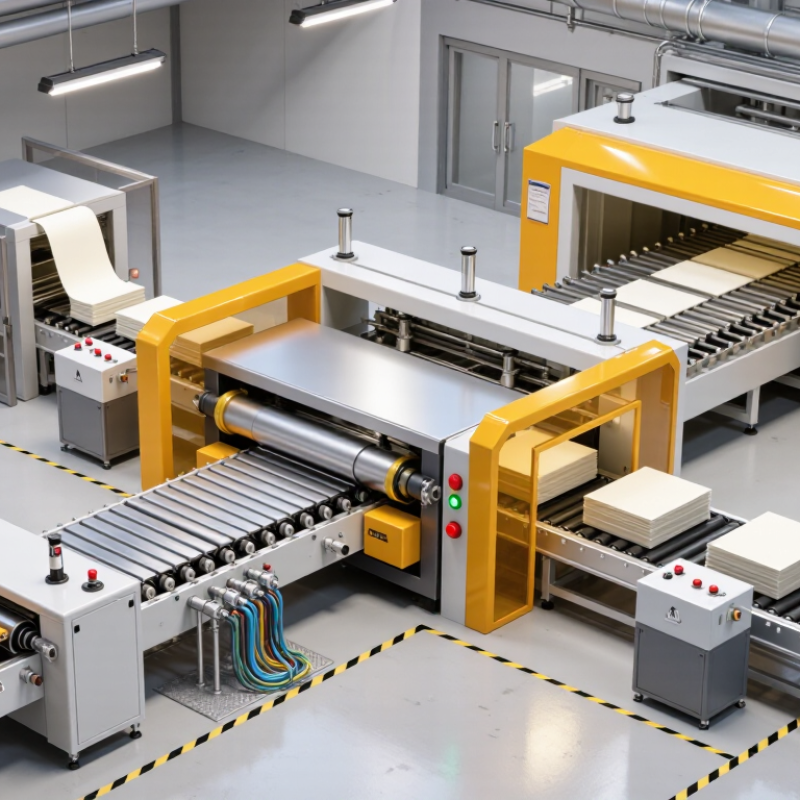
2026 How to Meet Safety Standards for Paper Forming Equipment

Map Paper-Forming Hazards with ISO 12100 Risk-Assessment Principles

Paper-forming equipment can look orderly while hiding severe hazards. Rotating rollers create nip points, especially near feeding and rewinding zones. Cutting units may expose sharp edges during setup, cleaning, or jam removal. Compressed air can move parts unexpectedly. Paper dust also affects visibility, breathing comfort, and housekeeping.

ISO 12100 provides a practical structure for examining these risks. Define the machine’s intended use, then consider foreseeable misuse. Include operators, maintenance workers, contractors, and visitors. Observe real tasks, not only normal production. A short stop often changes behavior. Our first assessment once focused on running speed and missed manual web clearing. That was a useful correction.

Record each hazard with its location, cause, possible injury, and existing control. Estimate severity and probability before selecting safeguards. Prefer inherently safer design, such as reducing access to moving parts. Add fixed guards, interlocked doors, presence-sensing devices, and reliable isolation procedures where needed. Clear instructions support these controls but should not replace them. Test safeguards during realistic conditions, including startup, material changes, cleaning, and fault recovery. Ask workers what actually happens under pressure. Their answers may challenge the written procedure. Risk reviews should also change after modifications, incidents, or repeated near misses. No assessment is perfect. It becomes reliable through evidence, careful observation, and honest revision.

Specify Guards and Interlocks Under OSHA 1910.212 and ISO 14120

Paper forming equipment creates narrow, fast-moving hazards around rollers, forming dies, cutters, and transfer points. A hand can enter these spaces before an operator notices the movement.

OSHA 1910.212 requires guarding against point-of-operation hazards, nip points, rotating parts, and flying materials. OSHA’s FY 2023 enforcement data recorded 1,644 machine guarding violations. That figure shows why guarding cannot remain an afterthought. Fixed guards should withstand expected impact and resist removal without tools. Openings must prevent fingers from reaching hazardous motion.

ISO 14120 provides practical requirements for guard construction, visibility, strength, and safe access. It does not replace a machine-specific risk assessment. For access doors, specify interlocks that stop hazardous motion before entry is possible. The design should also prevent automatic restart after the door closes. A trapped-key or monitored guard arrangement may suit frequent maintenance areas. Keep the distinction clear: ISO 14120 addresses guards, while related interlocking standards guide device selection.

BLS reported 5,283 fatal occupational injuries in the United States during 2023. Not every incident involved machinery, but the scale reinforces disciplined prevention. During commissioning, test each guard with gloves, tools, and realistic paper jams. Record stopping time, access distance, and reset behavior. A practical design is rarely perfect on its first review. Maintenance teams may still find awkward access points or tempting shortcuts. Revise those details before production pressure makes them normal.

Select Safety Controls Using ISO 13849-1:2023 PL d, Category 3

2026 How to Meet Safety Standards for Paper Forming Equipment

Paper forming equipment has exposed nip points, cutters, and stored pneumatic energy. These hazards can cause severe injuries during clearing or maintenance. The International Labour Organization estimated 2.93 million work-related deaths in 2024. It also reported about 395 million non-fatal occupational injuries annually. These figures show why functional safety deserves practical attention, not paperwork alone.

ISO 13849-1:2023 helps engineers select safety controls using Performance Level. For many serious hazards, PL d with Category 3 is an appropriate design target. Category 3 requires redundant safety channels and monitoring of single faults. Typical controls include dual-channel guard switches, monitored emergency stops, safe motion interruption, and controlled pneumatic exhaust. Designers must calculate MTTFd, diagnostic coverage, and common-cause failure measures. A neat calculation can still hide a bad assumption. I would verify the real machine, especially during jam removal and unexpected restart conditions. ISO 13849-1:2023 does not certify the entire machine by itself. Validation must confirm wiring, software logic, stopping time, access distance, and reset behavior.

Tips: Photograph each hazard zone before selecting controls. Test one fault at a time. Disconnect air and electrical energy during service trials. Record failed tests honestly; a weak result is useful evidence. The European Agency for Safety and Health at Work stresses that risk assessment should reflect actual work practices, not ideal procedures. For paper equipment, observe operators handling sheets, dust, and rejected material. Their shortcuts may reveal gaps that the original assessment missed.

2026 How to Meet Safety Standards for Paper Forming Equipment — Select Safety Controls Using ISO 13849-1:2023 PL d, Category 3
Safety Dimension Application on Paper Forming Equipment Recommended Safety Control ISO 13849-1:2023 Design Target Verification Evidence
Required Performance Level Hazards may include crushing, shearing, drawing-in, cutting, and unexpected movement at forming, feeding, trimming, or discharge zones. Determine the required performance level for each hazardous motion through a documented risk assessment before selecting the control architecture. PLr d where the risk assessment requires it Risk assessment identifying the hazard, exposure, avoidance possibility, severity, and assigned PLr.
Safety Architecture Loss of one electrical or electronic safety-related component must not immediately result in loss of the safety function. Use a two-channel safety circuit with suitable monitoring, redundant switching elements, and fault detection. Category 3 Safety block diagram, channel separation review, fault-exclusion rationale, and SISTEMA or equivalent calculation.
Achieved PFHD Safety functions controlling hazardous motion must maintain sufficiently low probability of dangerous failure per hour. Calculate the complete safety-related control system, including input devices, logic, output devices, wiring, diagnostics, and common-cause factors. PL d: PFHD ≥ 1 × 10⁻⁷ and < 1 × 10⁻⁶ per hour Validated calculation using component failure data, mission time, diagnostic coverage, common-cause analysis, and subsystem parameters.
Diagnostic Coverage Faults in redundant channels, feedback circuits, switching devices, or safety input wiring should be detected within the required fault-detection interval. Monitor cross-circuit faults, discrepancy between channels, welded contacts, and loss of feedback where applicable. Medium DCavg is commonly associated with Cat. 3 designs for PL d; calculate the actual value Diagnostic function specification, fault-injection test records, response-time measurements, and diagnostic coverage calculation.
Emergency Stop Operators may need to stop hazardous forming, feeding, or conveying movements during abnormal situations. Provide readily accessible emergency-stop actuators and connect them to a validated stop function appropriate to the risk assessment. Performance level and stop behavior based on risk assessment Emergency-stop location plan, reset logic test, stop-time test, and confirmation that reset does not cause automatic restart.
Guard Interlocking Fixed or movable guards may protect access to rollers, dies, forming tools, cutting devices, and in-running nip points. Use coded or monitored guard interlocking devices where defeat or bypass could reasonably be expected; prevent hazardous motion while access is open. PLr assigned per access point; Cat. 3 architecture where PL d is required Guard-interlock selection record, actuator-alignment review, tamper-resistance assessment, and opening/closing tests.
Presence-Sensing Devices Frequent operator access or material-loading tasks may require detection rather than physical guarding alone. Use appropriately selected light curtains, laser scanners, pressure-sensitive devices, or similar protective equipment with monitored outputs. Device and safety function must achieve the assigned PLr Detection-zone validation, minimum-distance calculation, resolution check, muting or blanking validation, and fault-response test.
Safe Stop Function Stopping the forming mechanism may involve removal of power, controlled deceleration, or prevention of restart depending on the hazard. Define the required stop function and interface it with the drive, motor contactors, brakes, or other final switching elements. Stop Category 0 or 1 selected from the risk assessment Stop-category rationale, measured stopping time, residual-energy assessment, and restart-prevention test.
Final Switching Elements Dangerous movement can persist if a contactor welds, a valve sticks, a brake fails, or a drive remains enabled. Use redundant, monitored final switching elements where required; include feedback such as mechanically linked contacts or equivalent diagnostics. Final subsystem must support the complete PL d calculation Contactor or actuator data, feedback monitoring test, weld-fault test, and calculated MTTFD/DC contribution.
Mean Time to Dangerous Failure Reliability of safety-related components affects the achievable performance level over the intended service period. Select components with suitable manufacturer reliability data and define a realistic mission time, operating cycle, and demand rate. MTTFD category is calculated for each channel and subsystem Manufacturer data source, B10D or failure-rate calculation, operating-cycle assumptions, and service-life records.
Common-Cause Failure Redundant channels can fail together because of wiring errors, shared power supplies, environmental stress, electromagnetic interference, or maintenance errors. Apply physical separation, protected cable routing, suitable power architecture, environmental controls, and systematic checks for common causes. Adequate common-cause measures; verify scoring using the applicable assessment method Common-cause failure checklist, wiring inspection, EMC assessment, power-supply review, and environmental qualification records.
Reset and Restart Prevention Closing a guard or restoring power must not cause unexpected hazardous movement. Use a deliberate, manually operated reset outside the danger zone with clear visibility where practicable; require a separate start command. Reset must not initiate automatic restart Reset-location review, visibility assessment, restart test after guard closure, power restoration, and fault recovery.
Access and Maintenance Mode Setup, threading, tool changes, cleaning, and maintenance can expose personnel to hazardous movement. Provide controlled operating modes, reduced speed or force where justified, enabling devices, hold-to-run controls, and secure isolation procedures. Each mode-specific safety function receives its own PLr Mode-selection logic test, access authorization review, limited-speed measurement, enabling-device test, and maintenance procedure.
Validation The completed machine must demonstrate that safety functions perform as specified under normal operation and reasonably foreseeable faults. Validate the safety-related control system by analysis and testing, including input, logic, output, response time, fault behavior, and environmental conditions. Validation required before placing the machine into service Validation plan, test protocol, test results, unresolved-fault register, final safety-function list, and approval record.
Documentation and Change Control Changes to sensors, drives, guarding, software, wiring, or operating modes can alter the achieved performance level. Maintain controlled schematics, safety requirements specifications, software versions, parameter records, inspection intervals, and modification approvals. Safety lifecycle evidence retained for the machine’s service period Technical file, revision history, inspection checklist, proof-test schedule, training records, and updated performance-level calculation.
Technical note: PL d and Category 3 are design outcomes that must be confirmed for each individual safety function. The final selection depends on the machine risk assessment, subsystem data, diagnostic coverage, common-cause measures, stopping performance, and validation results. ISO 13849-1 provides the methodology for designing and evaluating safety-related parts of control systems; it does not replace the applicable machine-specific risk assessment or other relevant machinery safety requirements.

Verify Electrical Safety Against IEC 60204-1:2016 and NFPA 79

2026 How to Meet Safety Standards for Paper Forming Equipment

Verify the machine’s electrical design against IEC 60204-1:2016 and NFPA 79. These standards address wiring, protective bonding, disconnecting means, control circuits, and emergency stop functions. They are related, but they are not identical. A paper forming machine may need evaluation under both standards, depending on its installation location and authority requirements.

Check that the main disconnect is accessible, clearly labeled, and capable of isolating all relevant power sources. Confirm conductor sizing, overcurrent protection, grounding continuity, and enclosure protection. Test emergency stop devices from several operating conditions. The machine should stop safely without creating a new hazard. Inspect terminals for loose connections, especially near motors and high-vibration areas. Labels matter. Keep schematics inside or near the control enclosure. Record test results, revisions, and corrective actions. A checklist alone can still miss an unsafe detail.

Tips: Use a qualified electrical professional for verification. Compare the finished machine with its drawings, not only its intended design. Test protective bonding with calibrated equipment. Review the installation with the local authority when requirements are unclear. Do not guess. I have found that small documentation gaps often delay acceptance more than visible wiring problems. That weakness deserves attention.

2026 Paper Forming Equipment Safety Verification

Safety topics addressed by both IEC 60204-1:2016 and NFPA 79. A value of 1 means the standard addresses the verification topic; it is not a compliance score.

Both standards address core electrical-safety verification activities, including protective bonding, insulation resistance, dielectric withstand, emergency-stop functions, and functional testing. The applicable edition, equipment design, rated voltage, and local adoption requirements must be confirmed before testing.

Document LOTO, Validation, and Training for 2026 Compliance Audits

In 2026, safety audits for paper forming equipment will examine evidence, not promises. A signed LOTO procedure should identify every electrical, pneumatic, hydraulic, and stored-energy source. It should name authorized employees, isolation points, verification steps, and release conditions. Photos of locked disconnects help, but they never replace field verification. Test zero energy with a calibrated meter where appropriate, then record the result.

Validation must connect machine design with real operating risks. Record guard checks, interlock tests, emergency-stop tests, and restart prevention results. Include the date, equipment ID, tester, method, findings, and corrective action. Our first checklist was too general. It missed trapped pressure inside a forming station. That gap changed our review process. Validation records should show repeatable tests, not copied signatures. Keep revision histories visible.

Training records need the same discipline. Keep role-based instruction, practical demonstrations, refresher dates, and short assessments. Ask operators to explain why each control works. Watch them isolate a feeder, clear a jam, and restore service under supervision. A classroom slide deck is not proof of competence. Train again. We document failed demonstrations and retraining without hiding them. Auditors often trust honest gaps more than perfect paperwork. Review records against applicable workplace requirements and internal procedures before the audit. Keep files accessible near the machine and in a controlled digital register.

FAQS

What hazards commonly appear on paper-forming equipment?

Rotating rollers can create nip points near feeding and rewinding areas. Cutting units may expose sharp edges. Paper dust can reduce visibility and breathing comfort.

Who should be included in a machine risk assessment?

Include operators, maintenance workers, contractors, and visitors. Observe real work, including cleaning, setup, jams, and short production stops.

What should each recorded hazard contain?

Record its location, cause, possible injury, and existing control. Estimate severity and probability before choosing safeguards.

Which safeguards should be preferred?

Reduce access to moving parts through safer design. Add fixed guards, interlocked doors, presence sensors, and reliable energy isolation.

Why should written instructions not replace physical safeguards?

Workers may act differently under pressure. A clear instruction cannot stop a roller or prevent unexpected movement by itself.

How should electrical safety be verified?

Check disconnects, conductor sizing, overcurrent protection, grounding continuity, and enclosure protection. Test emergency stops in several operating conditions.

What should an energy-isolation procedure identify?

Identify electrical, pneumatic, hydraulic, and stored-energy sources. Name isolation points, authorized workers, verification steps, and release conditions.

What evidence should validation records include?

Record guard checks, interlock tests, emergency-stop tests, and restart-prevention results. Include the date, equipment ID, tester, method, findings, and corrective action.

How can training prove practical competence?

Watch workers isolate a feeder, clear a jam, and restore service under supervision. Short demonstrations reveal more than classroom slides.

When should the risk review be repeated?

Review it after modifications, incidents, and repeated near misses. No assessment stays perfect. Evidence should change the document.

Conclusion

This guide explains what safety standards apply to paper forming equipment and how to use them as a practical compliance framework for 2026. It begins with ISO 12100 risk-assessment principles to identify hazards such as crushing, cutting, entanglement, unexpected movement, and access to forming areas. It then addresses the design and selection of fixed and movable guards, interlocks, and protective devices in line with OSHA 1910.212 and ISO 14120.

The article also outlines how ISO 13849-1:2023 can guide the selection of safety-related control systems targeting Performance Level d and Category 3 where the risk assessment requires it. Electrical design and protective measures should be verified against IEC 60204-1:2016 and NFPA 79. Finally, effective 2026 audit preparation depends on clear lockout/tagout procedures, documented validation results, maintenance records, operator training, and evidence that safeguards remain effective throughout the equipment’s service life.

Amelia

Amelia

Amelia is a seasoned marketing professional with a wealth of expertise in our company’s core offerings. With an unwavering passion for driving growth and innovation, she plays a pivotal role in shaping our marketing strategies and enhancing brand visibility. A key aspect of her responsibilities......