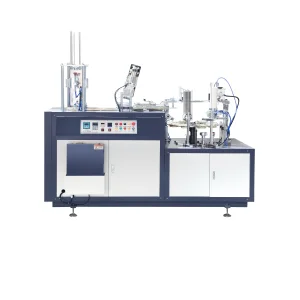
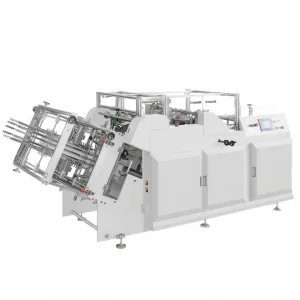
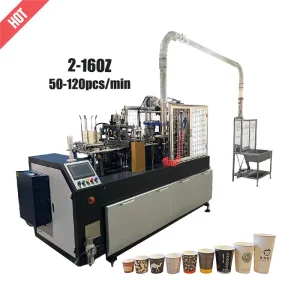
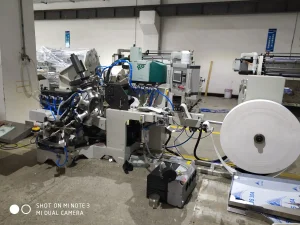
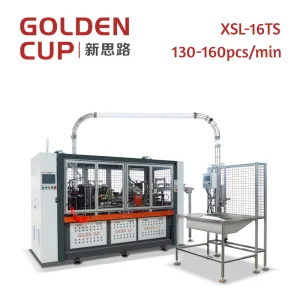
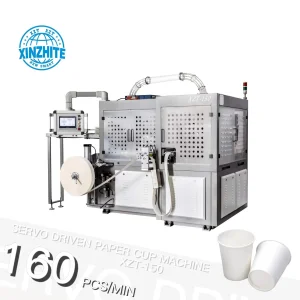
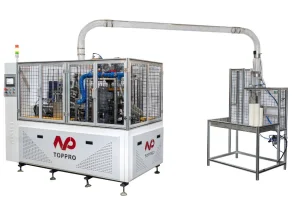
Explore our leading selection of industrial paper cup and bowl forming systems engineered for precision performance.
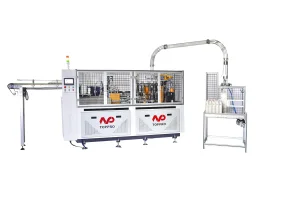
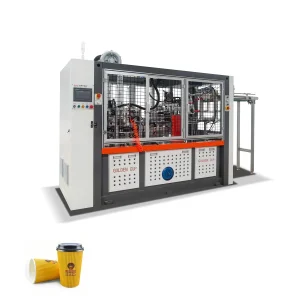
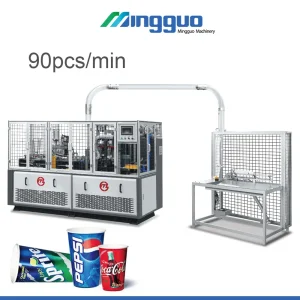
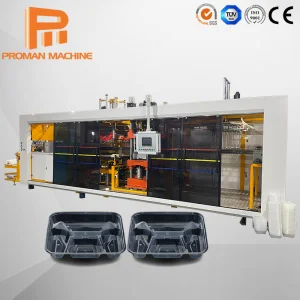
Within the modern paper container manufacturing segment, the paper cup curling machine serves as a critical mechanical threshold. The curling process determines the rigidity, sealing properties, and lid fitment tolerance of the final product. A poorly executed curl results in structural failure, leaks, and line shutdowns during automated filling operations.
Top global exporters focus on integrating advanced heating, pre-heating, and multi-stage rotary curling mechanisms. These systems allow operators to fine-tune the dimensional properties of the rim, accommodating variations in paper density, PE coatings, and bio-polymer (PLA) barriers.
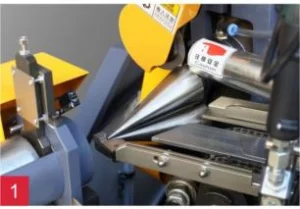
The curling station in a high-speed cup forming machine uses mechanical folders and heated dies to roll the top edge of a paper cylinder outwards. Precision controllers ensure that heat distribution is completely uniform. Unbalanced heating leads to localized paper scorching or incomplete roll profiles, rendering the batch non-compliant with food safety and mechanical integrity protocols.
Evaluating the mechanics behind high-efficiency paper container processing systems.
Traditional chain-driven machinery exhibits backlash over extended runtimes. Advanced machines employ cylindrical open-cam gear indexing systems, optimizing mechanical synchronization, minimizing friction, and securing tighter tolerances during the curling phase.
For double PE and PLA-coated cups, ultrasonic sealing units provide rapid heat bonding without compromising the material structure. This matches the thermal control required for complex bio-barrier applications.
By splitting the curling process into two distinct stages—pre-heating/pre-forming followed by final rotary compression—the paper board fibers are eased into shape, drastically reducing rim cracking defects.
Sourcing paper cup curling machinery from China, specifically the Ruian machinery industrial cluster in Zhejiang Province, provides significant cost and capability advantages. These geographic manufacturing clusters house complete raw material sourcing networks, high-precision tooling shops, and specialized heat treatment facilities.
This concentrated infrastructure allows local manufacturers to minimize component lead times, accelerate custom R&D cycles, and lower overall overhead. These efficiencies are passed on to international buyers in the form of cost-competitive CapEx and accessible spare parts supply chains.
Zhejiang's mechanical clusters specialize in scaling production. By grouping component manufacturers, sheet metal fabricators, and automation design studios together, companies like Zhejiang Jinli Machinery Co., Ltd achieve rapid cycle-time reductions without sacrificing build quality.
Whether you require single PE cold drink cup systems or multi-layer ripple wall sleeve units, the regional ecosystem maintains rigid compliance protocols. We carry these high standards from initial raw casting to the final assembly floor inspection.
Bridging the gap between eastern manufacturing hubs and international regulatory demands.
Global exports demand rigorous adherence to Machinery Directive 2006/42/EC and Low Voltage Directive 2014/35/EU. Quality equipment is shipped with complete CE certification, standardizing electrical cabinets, protective fencing, and emergency-stop matrices.
To reduce downtime, modern exporters offer remote PLC troubleshooting. Using integrated VPN modules, technicians based in China can analyze sensor arrays, modify timing diagrams, and resolve programming bugs within minutes.
Standardized tooling and die geometries ensure that replacement parts for curling rings, bottom-heating plates, and knurling wheels can be dispatched globally and swapped in without requiring custom machining.
The global packaging sector is undergoing a major shift away from traditional single-use plastics. Regulatory mandates—such as the EU's Single-Use Plastics Directive (SUPD)—are accelerating the adoption of aqueous-barrier coatings and PLA-coated board. This change directly affects the mechanical curling profile:
These thin water-based polymer dispersions require less heating to form a seal but are highly susceptible to micro-fracturing if the curling die is not polished and lubricated correctly.
PLA possesses a lower glass transition temperature than traditional PE. The curling machine must utilize precise PID temperature controls to prevent the resin from sticking to the forming dies.
As plastic-free regulations tighten, forming rims on uncoated paperboard requires specialized moisture-injection systems to temporarily soften the wood fibers during compression.
Zhejiang Jinli Machinery Co., Ltd is located in Feiyun New District, Ruian City, Zhejiang Province, with more than 50 employees and a factory area of about 2,000 square meters. It is an enterprise integrating scientific research, design, production, sales and service, specializing in the production of a series of complete sets of equipment for paper containers such as paper cup machines and paper bowl machines.
The company has strong technical force and sophisticated equipment, with an average annual output of about 10 million RMB. The products sell well all over the country and are exported to Germany, Egypt, the Philippines, Australia, New Zealand, Turkey, India, South Korea, Jordan, Oman and other countries and regions. Our main products are Paper Cup Machine, Fully Automatic Paper Bowl Machine, Paper Bowl Machine, Fully Automatic Paper Bowl Making Machine, Open Cam Paper Bowl Machine, Cup Cake Forming Machine, etc.

Addressing standard operational inquiries, setup tolerances, and procurement practices.
Curling quality is primarily driven by three parameters: consistent heating temperature at the rim prep station, mechanical sync of the indexing cam, and the lubrication level of the paper before curling. Too much moisture weakens the fiber structure, while lack of lubrication causes friction tears.
Yes. However, it requires a dedicated PLC system that can store unique parameter recipes. Since PLA requires a lower heat sealing threshold, temperature profiles must be tightly monitored via digital sensors to prevent the film from softening prematurely.
Industrial forming dies constructed from hardened alloy steel will run for 10-15 million cycles before showing tolerances drift. Regular cleaning, verification of heating element connections, and lubrication checks should occur every 80 operating hours.
We provide localized technical assistance documentation, visual setup guides, and remote online diagnosis. If physical intervention is required, we coordinate with regional machinery agents or dispatch specialized engineers from our plant in Ruian, Zhejiang.
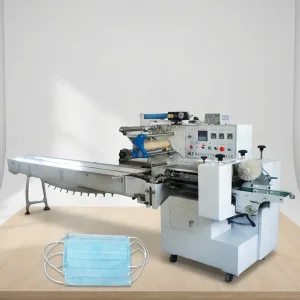
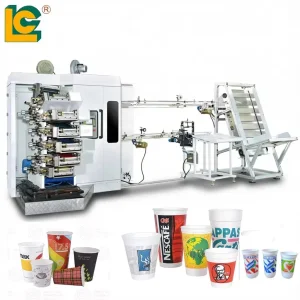
Complete your production floor with our printing, packing, and high-speed forming units.
 Jinli Machinery